Where Did All These Smells Originally Come From? The Story Before Perfume Became Perfume
Before there were perfume bottles, fragrance houses, department stores or laboratories, there was simply nature.
A flower opened and released an aroma.
A tree produced resin.
Wood released a distinctive smell when cut or burned.
Leaves released aromatic compounds when crushed.
Fruit peels released oils when squeezed.
Spices carried powerful aromas.
Long before humans understood the chemistry behind these experiences, we could smell them.
This is where the story of perfume begins.
At BRAINWAVE SCENT, understanding this history matters to us because our philosophy is simple:
BRAINWAVE studies, listens and creates from Africa.
Before we begin creating our own fragrances, we want to understand the world of scent that came before us.
And that takes us thousands of years into human history.
Scent Existed Before Perfume
Humans did not invent smell.
Smell is part of the natural world.
Plants produce volatile chemical compounds for many biological reasons, including communication, attracting pollinators and defending themselves.
When some of those molecules reach receptors in our noses, our brains interpret the signals as smell.
What humans eventually discovered was that certain natural materials produced particularly interesting aromas.
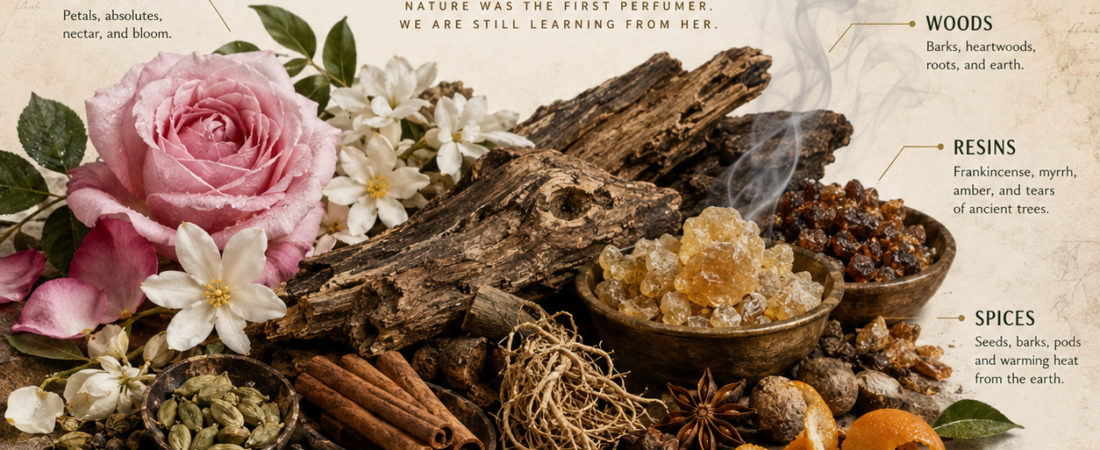
Flowers.
Herbs.
Woods.
Roots.
Spices.
Fruits.
Seeds.
Resins.
People began collecting, burning, crushing, soaking and combining these materials.
The history of perfumery grew from those observations.
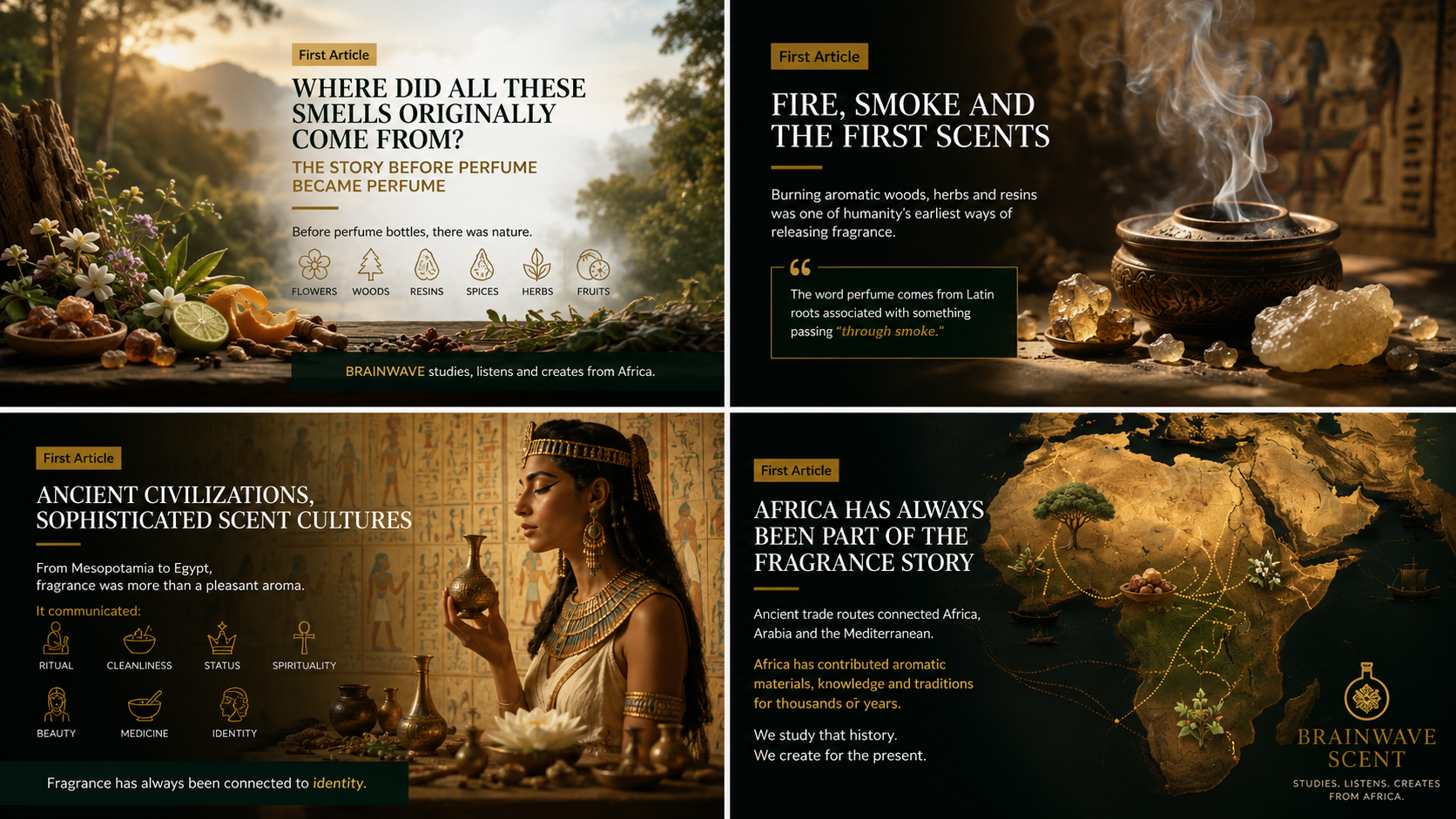
Fire May Have Been One of Our Earliest Encounters With Fragrance
Imagine humans thousands of years ago placing aromatic wood, herbs or resin into a fire.
Something happens.
Smoke rises, carrying an aroma through the surrounding space.
Long before the modern spray bottle existed, burning aromatic materials was one way humans could deliberately release fragrance.
This relationship between smoke, aromatic materials, ceremony and fragrance became important across many civilizations.
Resins such as frankincense and myrrh, for example, became highly valued aromatic materials.
They were burned, traded and incorporated into religious, medicinal and cosmetic traditions.
This also helps explain the word perfume itself.
It ultimately comes through Latin roots associated with the idea of something passing “through smoke.”
Perfume’s story therefore did not begin with spraying liquid onto the neck.
It began much more broadly with humanity’s relationship with aromatic materials.
Humans Began Learning How to Capture Smell
Burning an aromatic material releases its aroma—but the smell eventually disappears.
So humans faced an interesting problem:
Can we capture fragrance?
Early fragrance traditions developed techniques involving aromatic materials infused into fats and oils.
Flowers, herbs, woods, spices and resins could be processed so their aromatic character was transferred into another substance.
That was a major conceptual development.
Instead of only smelling a flower while standing beside it, humans were gradually learning how to take something aromatic from nature and transform it into a product that could be stored, transported and used.
Ancient Civilizations Developed Sophisticated Fragrance Cultures
Several ancient civilizations played important roles in the development of perfumery.
Mesopotamian traditions are particularly significant in early fragrance history.
One frequently discussed historical figure is Tapputi, associated with Mesopotamian perfume-making in the second millennium BCE. Records connected with early perfumery describe sophisticated handling of aromatic materials.
Ancient Egypt also developed a remarkable culture around scent.
Fragrant oils, incense and aromatic preparations were connected with religious ceremonies, personal grooming, medicine and burial traditions.
Materials including resins, flowers, herbs and spices were used to create aromatic preparations.
Perfume was therefore much more than something that made a person smell attractive.
It could communicate:
ritual
cleanliness
status
spirituality
beauty
medicine
and identity.
This relationship between fragrance and identity remains important thousands of years later.
Africa Was Already Part of the Fragrance Story
This history is especially important to BRAINWAVE.
The story of fragrance should not be imagined simply as:
France → modern perfume → rest of the world.
The history is much older and geographically broader.
North and Northeast Africa were deeply connected to ancient aromatic traditions and trade networks.
Egypt developed sophisticated fragrance practices.
Aromatic resins and materials moved through trade routes connecting parts of Africa, Arabia and the Mediterranean world.
African landscapes also contain aromatic materials that have been valued locally and internationally.
So when BRAINWAVE says that we create from Africa, we are not suggesting that Africa is entering the fragrance conversation for the first time.
Africa has been connected to humanity’s relationship with aromatic materials for thousands of years.
Our challenge is to study that history while creating something relevant to the present.
From Raw Material to Fragrance Ingredient
Eventually humans developed increasingly sophisticated methods for extracting aromatic materials.
Some of the major approaches that became important include:
Distillation
Steam or water can help separate volatile aromatic compounds from plant materials.
The resulting aromatic material can become an essential oil.
This technique became extremely important in perfumery.
Expression
Some materials—particularly citrus peels—contain aromatic oils that can be mechanically extracted.
Think about squeezing an orange peel near your fingers.
You can sometimes see tiny droplets being released.
Those droplets contain aromatic compounds.
Solvent Extraction
Some flowers and plant materials do not respond ideally to steam distillation.
Other extraction processes can capture their aromatic components, eventually producing materials such as absolutes.
Modern perfumery has developed additional extraction technologies as well.
The important principle remains:
The perfumer needs aromatic materials that can be measured, combined and reproduced.
Modern fragrance production therefore begins with a remarkable global supply chain.
According to the International Fragrance Association (IFRA), natural fragrance materials today include flowers, woods, resins, spices and citrus peels that can be distilled or extracted before reaching the perfumer.
Flowers Gave Perfumers an Entire Vocabulary
Consider flowers.
Rose can smell dramatically different from jasmine.
Jasmine differs from tuberose.
Tuberose differs from orange blossom.
Orange blossom differs from violet.
Even within a particular flower, geography, species, cultivation and extraction can influence the aromatic material.
Eventually perfumers began grouping these characteristics into what we now broadly describe as floral fragrances.
This is directly relevant to our development of Romance Indulge, where BRAINWAVE is exploring a floral and spicy direction.
We aren’t simply asking:
Which flower smells good?
We eventually need to ask:
What emotional role should the floral element play?
Soft?
Sensual?
Creamy?
Bright?
Romantic?
Rich?
The history of scent gives us materials.
Perfumery gives us choices.
Woods Created Another World of Smell
Humans also discovered enormous differences among aromatic woods and woody materials.
Cedar can create one impression.
Sandalwood another.
Vetiver contributes another kind of woody-earthy character.
Patchouli can create yet another.
Agarwood—the source associated with natural oud—develops a particularly complex aromatic character under specific biological circumstances.
These materials eventually contributed to what modern perfumery describes broadly as woody fragrances.
This matters greatly to BRAINWAVE because wood currently appears in two areas of our first collection:
Romance Exclusive — Aromatic & Woody
and
Romance Beyond — Woody & Fresh
The challenge is that these perfumes must not smell identical simply because both contain a woody direction.
That is where composition begins.
Spices Became Smell, Not Just Taste
Pepper.
Cardamom.
Cinnamon.
Clove.
Ginger.
Nutmeg.
We usually associate spices with food.
But smell and taste are closely connected experiences, and many spices contain powerful aromatic molecules.
Perfumers learned to use these materials to introduce warmth, brightness, sharpness, complexity and sensuality.
That historical discovery eventually contributes to the direction we’re exploring with:
Romance Indulge — Floral & Spicy.
Again, our question isn’t simply:
Which spices can we put inside?
It is:
What kind of emotion should spice create around the floral heart?
Nature Gave Us the Beginning—but Not the Entire Modern Perfumer’s Palette
For much of human history, perfumery depended heavily on materials obtained from nature.
But nature presents limitations.
Some aromatic materials are extremely expensive.
Some are inconsistent from harvest to harvest.
Some require enormous quantities of plant material.
Some may present sustainability challenges.
Some smells cannot practically be extracted from their natural source.
And some desirable scent effects simply don’t exist in nature in a form that can be bottled.
Then something revolutionary happened.
Humans stopped only extracting smells.
Scientists began understanding the molecules responsible for smells.
And eventually they learned how to create aromatic molecules themselves.
That moment changed perfume forever.
Why BRAINWAVE Is Studying This
BRAINWAVE SCENT is currently at the beginning of its own fragrance journey.
Our first collection explores four directions:
Romance Exclusive — Aromatic & Woody
Romance Seduction — Amber & Oud
Romance Indulge — Floral & Spicy
Romance Beyond — Woody & Fresh
But before choosing individual materials, we believe we should understand where the language of fragrance came from.
Why do woods matter?
Why have humans valued flowers?
Why do spices communicate warmth?
Why have resins been treasured for thousands of years?
How did humans learn to capture these smells?
Those questions take us deeper than simply asking what perfume is popular today.
They take us back to the relationship between human beings, nature, culture and smell.
That is where our research begins.
Because before BRAINWAVE creates, BRAINWAVE studies.
And the deeper we study fragrance’s past, the better questions we can ask about its future.
BRAINWAVE SCENT
Studies. Listens. Creates from Africa.